
You don’t have to give up your phone to stop feeling owned by it. The goal is control, not abstinence.
You unlocked the phone to answer one message. You’re now twenty minutes deep into a video about someone restoring a boat.
You don’t own a boat.
Here’s the part worth staring at. You can remember the message. You cannot remember the moment you decided to watch a stranger sand a hull. Somewhere between those two things, a decision didn’t get made.
That’s a more defined problem than “I’m addicted to my phone,” and a much better one to have. You don’t need to want your phone less. You need a decision to exist in those moments where right now, there isn’t one.
Here are six steps to get there.
- Name your triggers. The moments, emotions, and moods right before you reach.
- Build the replacement. Intentional phone use, plus a healthier alternative in the gap.
- Reduce gradually, not cold turkey. Shrink the habit instead of going to war with it.
- Redesign the environment. Make the reach harder and the alternative easier, ahead of time.
- Add friction with settings. App limits, grayscale mode, batched notifications.
- Use tools as scaffolding, and get real support if it’s heavier than a habit.
Educational content, not medical advice. Move the steps around if your situation calls for it, since that order is mine rather than a clinically validated program, and no step here comes with a promised outcome or timeframe. There’s more depth on each one in the full reduce-screen-time guide.
Before any of them, though, it’s worth knowing why the obvious approach has never worked for you.
Why this guide goes beyond willpower
You’ve tried harder. Trying harder didn’t work.
Does this sound familiar: You decide to cut back. You last a few days, maybe a week to a month. You feel some relief. Then you lose to the same moments, at the same times. Same couch, same hour, same apps.
That isn’t a character flaw. It’s a timing problem.
Which means the question has been wrong the whole time. Not “how do I resist my phone.” A better question is “how do I stop landing in the spots where resisting is the only move I’ve got left.”
The research points the same way. Duckworth, Gendler and Gross make a broader theoretical case, with supporting evidence: change the environment early and you lean on effort less later. Nobody has tested it on phones, so it’s a principle to work from rather than a finding about phone habits.
What happens in the few seconds before you land there, though, has been studied directly.
The habit loop: cue → check → informational reward
Research on phone checking describes a habit loop. A cue lands. A buzz, a flat minute, a room where you always scroll. That cue kicks off a check, and the check pays out fast with informational rewards. New message. Fresh feed. Something happened in the last ten minutes (Oulasvirta and colleagues, 2012, Wood and Rünger, 2016). Some people feel a flicker of relief in there too, though that varies person to person.
Short version. Cue → check → informational reward.
This loop closes before self-control kicks in. Your hand moves. Then you notice. That’s autopilot, and it’s why the decision keeps arriving twenty minutes into the boat video.
Which is better news than it sounds. A timing problem has fixes that a willpower problem doesn’t. You stop trying to win the moment and start moving upstream of it.
Upstream means knowing where your own loop fires. That takes a few days and some honesty.
Find your biggest trigger first
For two or three days, just observe your phone habits. Change nothing.
Every time the phone appears in your hand, write down what came right before. Where you were. What you were doing. What you were feeling. What you were avoiding.
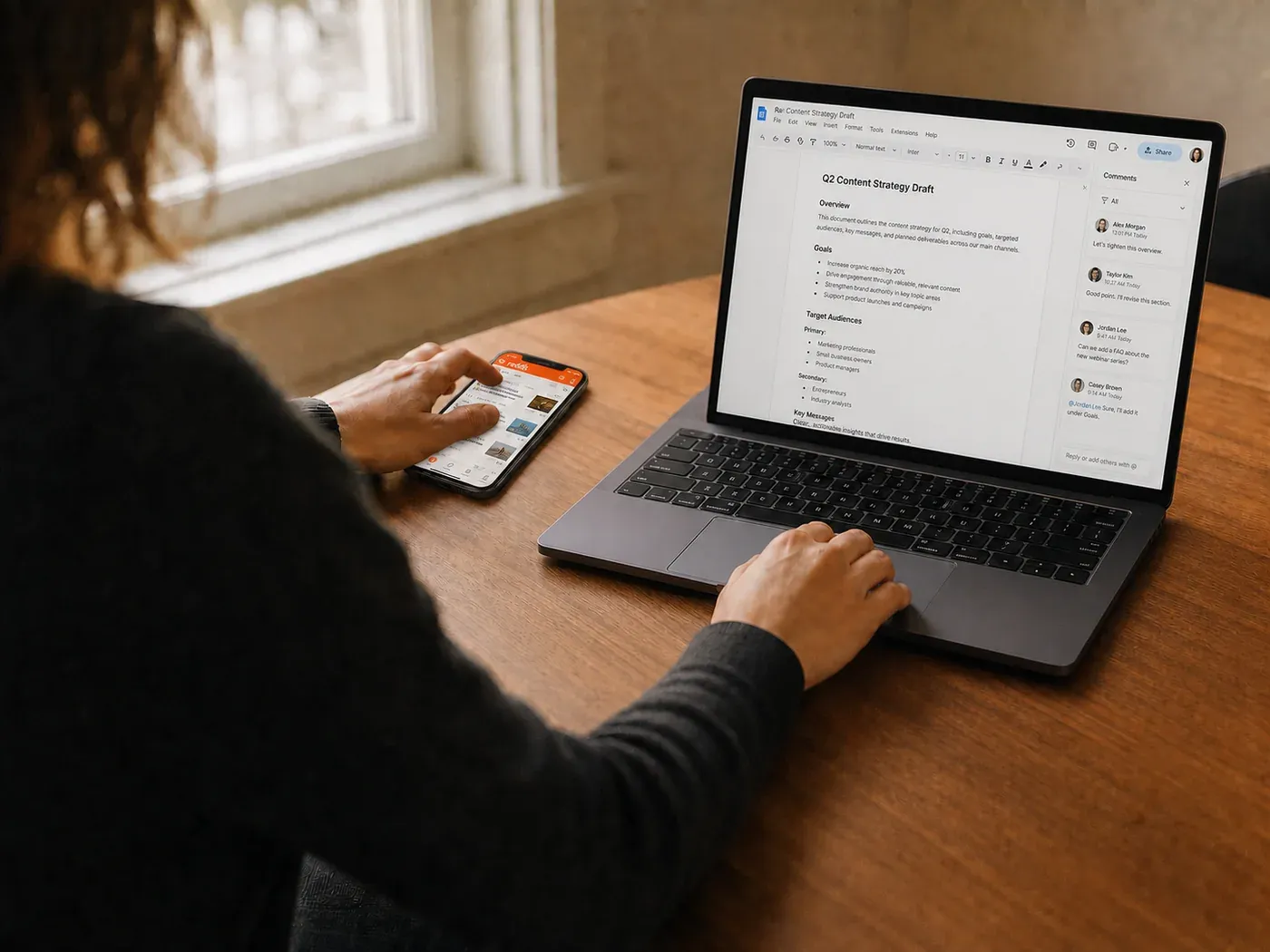
Your Screen Time report on iPhone, or Digital Wellbeing on Android, covers the other half. Which apps, which hours, for how long, and how many pickups.
Most people find a smaller problem than they feared. One app, maybe two. Three or four situations on repeat. The couch after dinner. Bed. Before work. In the bathroom. A lot of the time, you’re avoiding a task or just killing time before the next thing.
That’s good news. You’re not fixing your life. You’re fixing those moments.
One thing to ask yourself before you change anything, and this comes from motivational interviewing, a counseling style built on drawing out your own reasons for change instead of arguing you into them.
“What do you want that time back for?”
“To read” beats “to be better.”
Three days of observing a habit you want to change without trying to fix it is a lot to ask. If that’s too slow, one day is still better than none.
Knowing the moment is only half of it. The other half is having something ready for when it arrives. Something that fits the moment.
Rebuild the habit, don’t just block it
Blocking creates a vacuum. Vacuums refill.
So the move that pays the most dividends is deciding what the phone is for, and what those moments are for instead.
Replacement habits and intentional phone use
Intentional phone use means you pick it up to do something specific and put it down when you’re done. Like checking the weather or sending a text.
But what about the moments where there was nothing to be deliberate about, just a moment that felt like nothing, and the phone is the fastest available something?
That’s where a replacement behavior needs to be ready. A book on the arm of the couch. A puzzle app where the feed app used to be. Shoes by the door for the five o’clock slump.
Match it to the job the reach was doing. The couch scroll after dinner is usually about winding down, so a book might cover it.
Be specific here too. “Read more” loses. “Read five pages of my book” wins.
Then go slow as these replacements settle in. A controlled experiment with 619 people found that cutting daily smartphone use by one hour for a week meant reduced depressive and anxiety symptoms and higher life satisfaction, with most effects more stable at four-month follow-up than a temporary-abstinence condition. It’s one trial, not a guarantee. But it puts shrinking a habit on level footing with the more dramatic option, a digital detox, meaning a planned stretch of full or partial phone abstinence, and the evidence on digital detox is its own story.
Now the question everyone actually wants answered: how long will this take?
Nobody has established a timeline on curbing a phone addiction. A field study of habit formation tracking everyday eating, drinking and activity habits, not phone habits, found the forming of good habits took anywhere from 18 to 254 days, median 66.
A slow week is a data point, and a lapse, one evening that gets away from you, is expected.
Even with something ready and waiting, the urge still turns up. So it’s worth having a move for the moment itself.
Handling the urge (impulse control without white-knuckling)
Impulse control here means getting a beat in between the urge and the reaching, and the job is small. A few seconds.
- Name it. “Bored.” “Avoiding that email.”
- Move. Stand up, get water, step outside for a minute. Changing the scene can interrupt the automatic sequence.
- Ask what you came for. Phone already in hand? No answer, phone down.
These are practical tactics rather than validated interventions. The more moves you have ready, the more options you’re drawing from in that moment. But they all happen in the moment, which is the most difficult place to do this work. The easier move is making the moment come up less often.
Change the environment around the habit
If I could keep only one of the six steps, it would be this one.
Every other step asks something of you in the moment, which is exactly when you have least to give. For this step, you do the work once, and it keeps working when you’re not paying attention.
Designing screen-free zones and times
Screen-free zones and times are places and hours where the phone isn’t there at all, decided in advance rather than in the moment. Here are three worth trying.
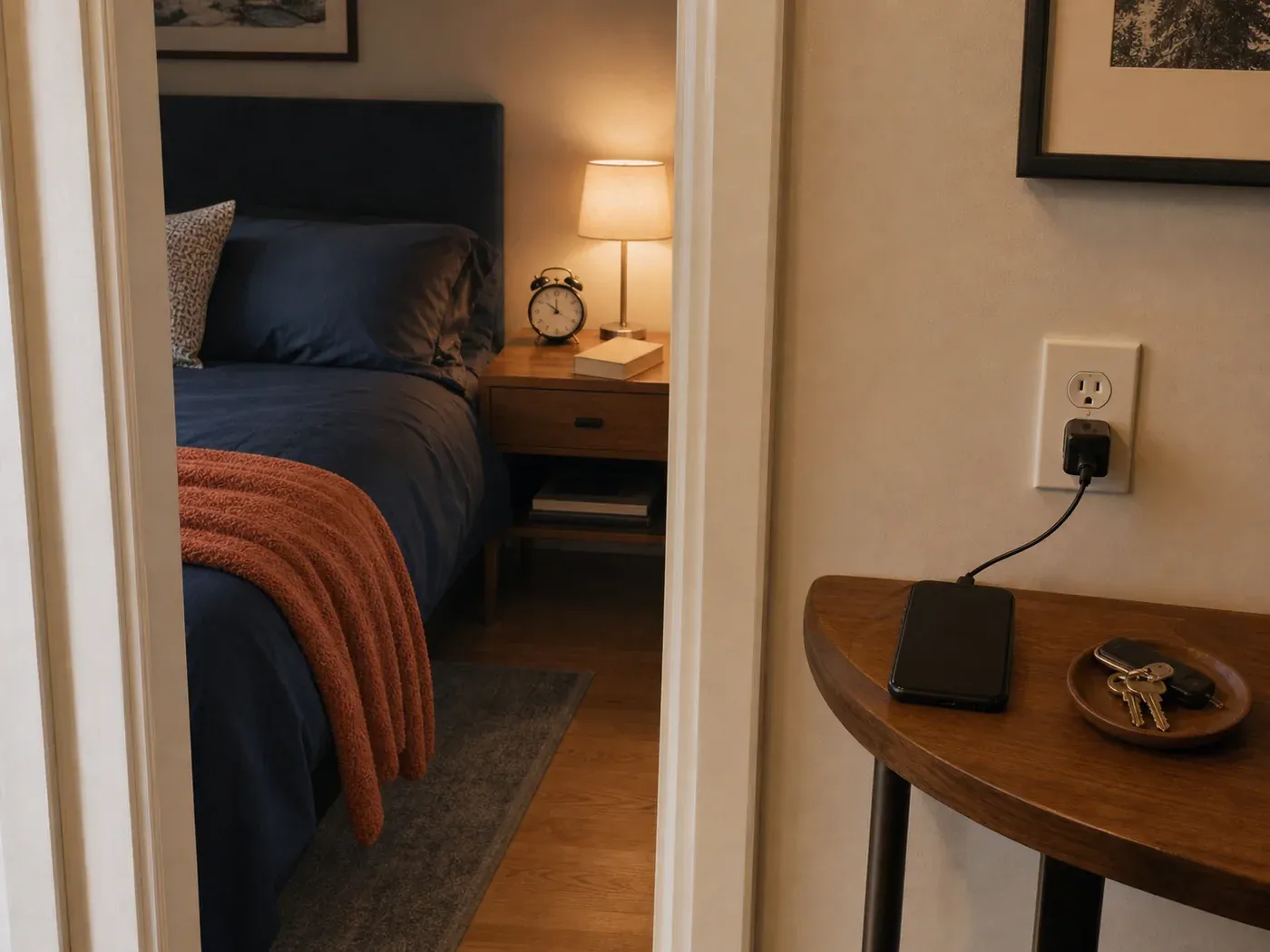
- The bedroom. The phone charges in another room. If it’s your alarm, a cheap clock pays for itself in a week.
- Meals. Phone off the table. The table is a place, and places carry cues.
- The first and last 30 minutes of the day. Peak autopilot. Nothing has your attention yet, or nothing is left.
NIH MedlinePlus Magazine covers similar ground in “7 tips for managing screen use”.
Decide each zone once, on a calm afternoon. Then the decision does the daily work instead of you having to rely on your self-control in the moment, which shows up late.
I’d start with the bedroom, and only the bedroom. All three at once is how this becomes a rule you resent by Thursday.
Settings that add friction: app limits, grayscale mode, batching notifications
| Setting | What it does | The catch |
|---|---|---|
| App limits | A daily limit per app, in Screen Time or Digital Wellbeing timers | A speed bump at best |
| Grayscale mode | Drains the color that makes the screen magnetic | Four taps to undo at 11pm |
| Batched notifications | Turns dozens of interruptions into a few scheduled ones | Barely any. This one hits the loop head on |
Grayscale is the one I’d try first, since it costs nothing and you can quit it in a second. A small randomized study with iPhone-using students found about 50 fewer minutes of screen time a day, and a separate uncontrolled one-week study of 84 people found about 20 fewer minutes, with unlocks unchanged.
Two more worth doing. Push the problem apps off your home screen, and switch off every notification that isn’t a person.
And if a limit annoys you, loosen it rather than delete it. A limit you can live with beats one you throw away.
That’s five of the six steps, and not one of them needed an app. Which raises the obvious question about all the apps that promise to do it for you.
What about apps and blockers?
Tools work best when they match the way you actually fail. So here’s what they do and where they help.
| Tool type | Mechanism | Best matched to |
|---|---|---|
| Built-in settings, Screen Time and Digital Wellbeing | Measurement, app limits, schedules | A baseline and your first limits, free |
| App blockers | Make chosen apps unreachable for a period | Focus blocks, override-prone patterns |
| Trackers and dashboards | Visibility into totals and opens | Time-blindness |
| Real-time coaching | Steps in at the moment of opening | Autopilot checking that sails past passive limits |
Where Screen Time, Digital Wellbeing, and app blockers fit, and their limits
Start with the built-ins. They’re free, already installed, and they cover measurement plus your first limits. App blockers, the third-party kind that make chosen apps unreachable for a set period, go further.
I overrode or uninstalled every one I ever set up. Deleting the app on Sunday and reinstalling it by Thursday became its own little ritual. It’s my experience, one person’s, not data, but the whole thing is written up in My Phone Addiction Story, in case it matches yours.
It isn’t only me, though. Tracking your use on its own doesn’t necessarily reduce it (Zimmermann, 2021), and reminders may get ignored at the moment of temptation, a pattern one recent randomized trial notes in its background literature.
The sharpest number comes from a field study of an app called one sec, conducted by researchers including the app’s creator. In that study, people closed the target app after the prompt roughly 36% of the time. They carried on past it roughly 64% of the time.
None of that means blockers fail for everyone, and no universal override statistic exists. It’s why they sit under the other five steps here rather than on top of them.
Zoom out to the whole category and a systematic review and meta-analysis reports a small-to-medium effect of digital self-control tools on time spent on distractive technological sources, with limited long-term evidence.
That’s the category on a good day: modest help, thin past the short term. It left me wanting a different mechanism entirely.
Real-time coaching as an alternative mechanism
That’s why I built Memento Mode. Instead of locking the door, it meets you as you’re turning the handle. Open a monitored app and it steps in right then, interrupting autopilot reaching in real time, coaching rather than blocking.
It’s one option among the ones in this guide, not treatment, and I’m not claiming it works better than the rest.
But if your failure mode is dismantling your own blockers, a tool aimed at the moment of reaching might be the right move.
When it’s more than a bad habit
Everything here treats heavy phone use as a habit problem. For some people it’s more serious, showing up as real damage to sleep, work or relationships, not just as time they’d rather have back. The sources I’ve reviewed have no validated checklist separating the two, so I’m not going to invent one.
If your phone use is seriously affecting your sleep, work, or relationships, and cutting back on your own hasn’t worked, talking to your doctor or a therapist is a reasonable next step. They can help you understand what may be contributing and what kind of support fits.
You don’t need a self-diagnosis to book it. “I keep trying to cut back and it isn’t working” is a complete reason, and it gives them plenty to work with.
Bring your notes and your Screen Time or Digital Wellbeing numbers. A concrete account of the pattern gives that first conversation somewhere to start.
Reaching out isn’t a failure of the method. That’s step six. Nothing to be ashamed of.
- Name your triggers. Two or three days of watching, plus your Screen Time or Digital Wellbeing data.
- Build the replacement. A ready replacement behavior for each real trigger, plus intentional phone use.
- Reduce gradually, not cold turkey. The strategy that one-hour-a-day trial supports.
- Redesign the environment. Bedroom, meals, and the first and last 30 minutes of the day as screen-free zones and times, each decided once.
- Add friction. App limits, grayscale mode, batched notifications, problem apps off the home screen.
- Scaffold with tools that match how you fail. And talk to your doctor or a therapist if cutting back on your own isn’t working.
Here’s an example of what this might look like, end to end.
It’s after dinner and you’re on the couch, wanting to wind down. That job used to belong to the phone. Now the book on the armrest has it, the phone is charging in another room.
None of this is going to stop you opening your phone for one message and surfacing somewhere unexpected. It happens. What changes is that the decision starts showing up on time. Most of the time you’ll surface on purpose.
You’ll still pick up your phone plenty. The difference is you meant to.
A pause that arrives before the scroll does.
Memento Mode opens the second you tap one of the apps that pull you in, and asks what you're actually after.


Nicholas Li is the founder of Memento Mode. He averaged seven hours a day on his phone at his worst and overrode every blocker he installed.


Sources
- Angela L. Duckworth, Tamar Szabo Gendler, and James J. Gross. Situational Strategies for Self-Control. Perspectives on Psychological Science (2016).
- Antti Oulasvirta, Tye Rattenbury, Lingyi Ma, and Eeva Raita. Habits make smartphone use more pervasive. Personal and Ubiquitous Computing (2012).
- Wendy Wood and Dennis Rünger. Psychology of Habit. Annual Review of Psychology (2016).
- Julia Brailovskaia et al. Finding the “sweet spot” of smartphone use: Reduction or abstinence to increase well-being and healthy lifestyle?! An experimental intervention study. Journal of Experimental Psychology: Applied (2023).
- Phillippa Lally, Cornelia H. M. van Jaarsveld, Henry W. W. Potts, and Jane Wardle. How are habits formed: Modelling habit formation in the real world. European Journal of Social Psychology (2010).
- 7 tips for managing screen use. NIH MedlinePlus Magazine (2025).
- Laura Zimmermann and Michael Sobolev. Digital Strategies for Screen Time Reduction: A Randomized Field Experiment. Cyberpsychology, Behavior, and Social Networking (2023).
- Cynthia A. Dekker and Susanne E. Baumgartner. Is life brighter when your phone is not? The efficacy of a grayscale smartphone intervention addressing digital well-being. Mobile Media & Communication (2023).
- Laura Zimmermann. “Your Screen-Time App Is Keeping Track”: Consumers Are Happy to Monitor but Unlikely to Reduce Smartphone Usage. Journal of the Association for Consumer Research (2021).
- Lea Mertens et al. Promoting Self-Regulated Social Media Use on Smartphones With a Mobile Intervention App (Wellspent): Randomized Controlled Trial. JMIR mHealth and uHealth (2026).
- David J. Grüning, Frederik Riedel, and Philipp Lorenz-Spreen. Directing smartphone use through the self-nudge app one sec. Proceedings of the National Academy of Sciences (2023).
- Alberto Monge Roffarello and Luigi De Russis. Achieving Digital Wellbeing Through Digital Self-Control Tools: A Systematic Review and Meta-Analysis. ACM Transactions on Computer-Human Interaction (2023).