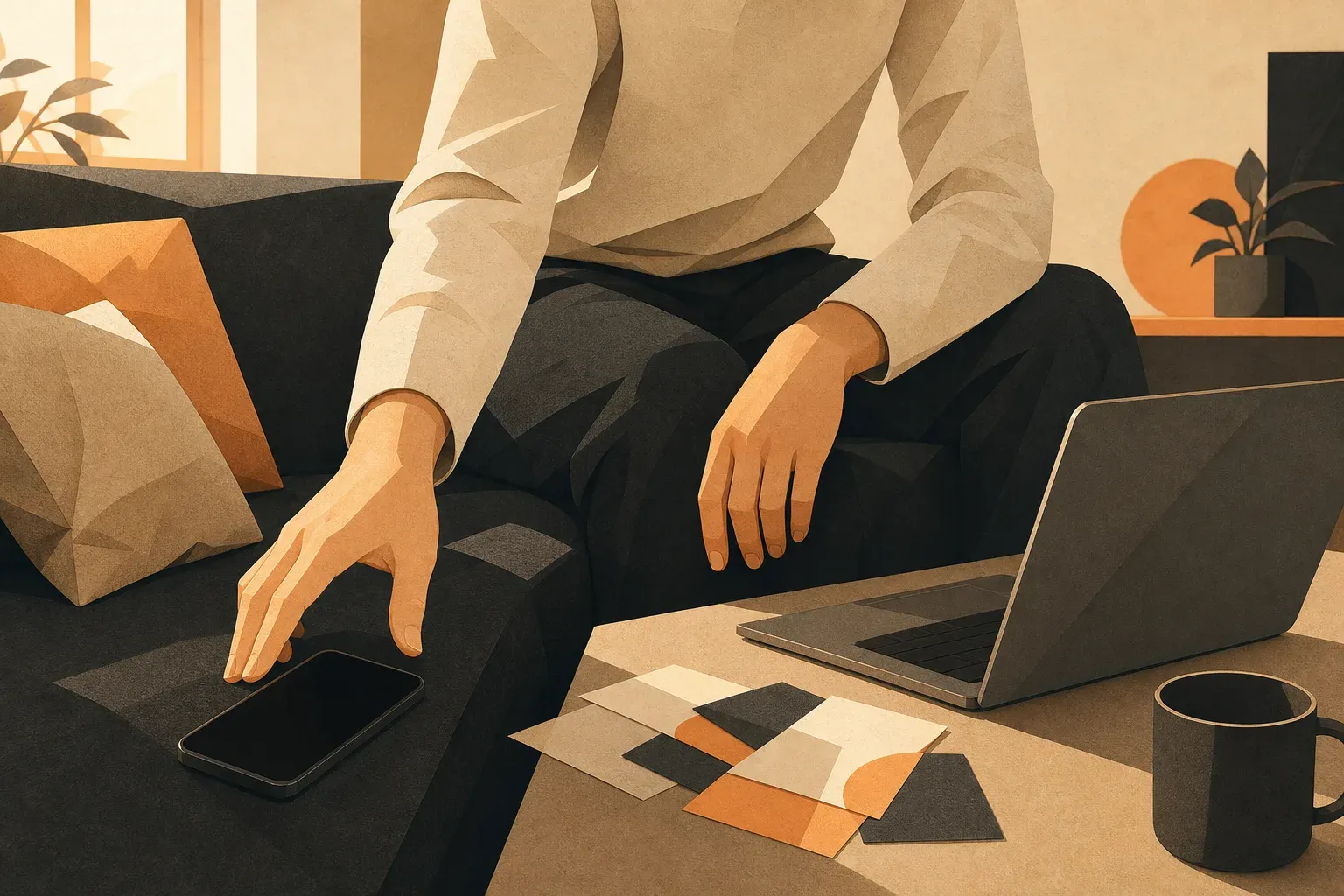
My phone addiction story began as an avoidance loop: difficult work sent me to YouTube or comics, the lost time created shame, and the shame sent me back to the phone.
The work I was avoiding
The worst of this happened while I was running that first business. My phone use averaged about seven hours a day and reached eleven at its worst. Difficult tasks and decisions would send me to basketball highlights or comics on the bed or couch. The first video felt like a break. One or two hours later, I was ashamed of the work and promises I had left unfinished, and I would scroll again to get away from that feeling.
Running the company meant there were things only I could do, at least until I learned to delegate them. Some were difficult. Some were scary. Some were annoying enough to make that Top 10 Dunks of the Year look urgent.
I knew what was waiting. My team had asked for answers. Clients were expecting work. I had given my word that I would follow through. I might make a small start, feel the discomfort of how much remained, then reach for my phone.
That discomfort was the trigger, the feeling or cue that fired the reach. YouTube and comics gave me somewhere else to go without leaving the room. The relief arrived fast. The work stayed put.
Then I would look at the time.
The shame did not send me back to the task. It made the task harder to face. I had lost an hour, broken a promise to myself, my clients or my team, and acted against an identity I cared about. I was supposed to be the entrepreneur who followed through. Instead, I was on the couch watching a feed that had grown dull long before I stopped.
That was my shame cycle: avoid the work, feel worse for avoiding it, then scroll to avoid that feeling too. The videos barely had to be good. They only had to keep the guilt one swipe away.
Deadlines eventually called. Fires started. I would put the phone down then, deal with the client issue, make the decision, and do the work I had spent hours avoiding. Afterward, I would promise myself I had learned my lesson.
I had learned it, but awareness and acknowledgement of the problem were only the first step.
Every fix worked until I needed my phone
I took each new setup seriously. I read books about habits and phone use. I tried app blockers, accountability partners, time-locked safes.
When I set a rule on purpose, I followed it.
For a while.
The blockers were the easiest to undo. I had already deleted the YouTube and Instagram apps, so Chrome became the route back to their websites. Blocking Chrome closed that route. It also removed the browser I needed for directions, restaurant reviews, travel research, and signing into services through Google.
Sooner or later, I needed Chrome for something real. I would uninstall the blocker, handle the legitimate task, and leave the block off. The route to YouTube was open again. A practical exception became the old setup, often without a clear moment when I chose that to happen.
The accountability arrangement came apart the same way. My partner held the password or access I needed to change the restrictions. I would ask for it for a valid reason, get through the immediate problem, and fail to rebuild the blocks. A cycle or two could pass before I set them up again.
The safe got in the way of calls and messages I needed to answer, so I stopped using it.
The tools did what I asked. The blocker blocked. The safe kept the phone inside. The accountability partner protected the settings. The trouble was that I needed the same device for work, travel, people I cared about, and the junk feed I used to hide from all three.
The restrictions could see access. They could not see intent. I could make them strict enough to interrupt my life, or flexible enough that I could dismantle them as soon as life gave me a good reason.
I kept rebuilding the same setup. Then a friend showed me a way to see the cost.
A life calendar made the cost real
A friend in active recovery from alcoholism showed me his life calendar, a life drawn as a finite grid, with one square for each passing week. He had accounted for his years and marked the good weeks alongside the weeks affected by his addiction.
I did not treat his addiction and my phone habit as the same thing. His calendar gave me a way to ask a question I had been avoiding: what would my own grid look like if I kept spending time at the same rate?
I was 30. I used 80 as the life-expectancy assumption and eight hours a day as a middle point for my phone use. That left 50 years. Eight hours is one-third of a day, and one-third of 50 is about 16.7.
At the same rate, I could spend nearly 17 of my next 50 years on my phone.
It was a rough projection, not a prediction. It still made seven or eight daily hours feel different. Those hours had looked bad on a weekly report, then disappeared into the next week. Seventeen years had weight.
My phone still had real work to do. I did not want all of those hours back. I wanted to stop giving so many away without knowing why. The total could show me the cost, but it could not interrupt the next reach.
The question appeared when I was present enough to ask it
During one stretch outside the worst of the cycle, I had enough presence of mind to notice my hand moving toward the phone. I had been reading about habits, cues, and triggers, and the ideas were close enough to reach in that moment.
Instead of opening the app, I asked:
Why am I reaching for this, right now?
Sometimes I was avoiding a task. Sometimes I was bored and had no idea what to do with the next few minutes. Sometimes I was anxious and wanted a place to put the feeling.
The answer was rarely flattering, but it was useful. Naming it was often enough to interrupt the reach, the small movement toward the phone that had been happening before I made a real decision. I could return to the work, choose another way to take a break, or open the app knowing what I wanted from it.
That choice mattered more to me than forcing the screen-time number down. I needed my phone. I liked parts of it. The problem was autopilot, the automatic use that started before I had named a reason.
For a time, the question gave me a pause. Then the cycle returned and exposed the weak spot in asking it.
Knowing the question was not enough
I could ask the question when I was present enough to notice the trigger. In the worst cycles, that presence was the first thing missing.
The question lived in my memory. The habit lived in my hand. On a hard morning, I could be inside Chrome before the useful thought showed up. By then, the basketball highlights had already started doing their job.
So I had a strange problem. I knew more about my pattern than I had before, but that knowledge depended on the same willpower I had been trying to stop depending on. The moment when I most needed the question was the moment when I was least likely to recall it.
A normal blocker could detect that I had opened Chrome. It had no idea whether I needed directions, a Google sign-in, or somewhere to hide from a decision. It treated necessary use and unconscious use as the same event. My workaround was to remove the restriction, which gave both kinds of use the same open door again.
I did not want a stronger lock. I wanted support that could meet me before the scroll, ask what was happening, and leave the choice in my hands.
So I built Memento Mode
By then I knew what the missing support had to do. In the worst cycles, asking the question still depended on willpower and presence of mind I did not have. A blocker could detect an app opening, but it could not tell necessary use from unconscious use. I wanted something that could ask what was happening before the scroll and leave the choice in my hands.
That became Memento Mode.
Memento Mode uses coaching, a short exchange that asks why you opened a monitored app and reflects that reason back before the feed takes over. It can then offer an alternative you chose earlier. The app does not have to decide that YouTube is bad or that Chrome is good. It gives you a chance to decide whether this particular opening is what you meant to do. You can see how the coaching works in the product walkthrough.
That distinction came from every restriction I had dismantled. I did not need a tool that won a fight against me. I needed one that could tell the difference between a call I meant to make and a feed I opened to escape a feeling, then put me back in the decision.
I had tried to solve the hours, the apps, and the access. The part I could never block was the reason I reached.
So I built it.
A pause that arrives before the scroll does.
Memento Mode opens the second you tap one of the apps that pull you in, and asks what you're actually after.

Nicholas Li is the founder of Memento Mode. He averaged seven hours a day on his phone at his worst and overrode every blocker he installed.

Sources
- Nicholas Li. Our Mission: reclaim your time. Memento Mode.
- How It Works: coaching in the moment. Memento Mode.